What it takes to make vegan shoes
PUMA increases its line-up of certified vegan shoes
January 18, 2021
PUMA is steadily increasing its offer for people who lead a vegan lifestyle and who want to avoid all kinds of animal products, not just in their food but also in their clothes. But what makes a vegan shoe vegan?
At first thought, neither the synthetic mesh nor the polyurethane soles of most of our running and training shoes contain animal products, but it’s not as simple as that, as Karol Trejo, Manager of Corporate Sustainability explains.
“Stearic Acids, which can be used as additives in the production process, often are derived from animal fats. Glues may contain bones, hides, rabbit skin, hoofs or gelatine,”
Karol says.
Karol says.
So if we want to make a vegan product, we have to make sure that none of those ingredients are used.
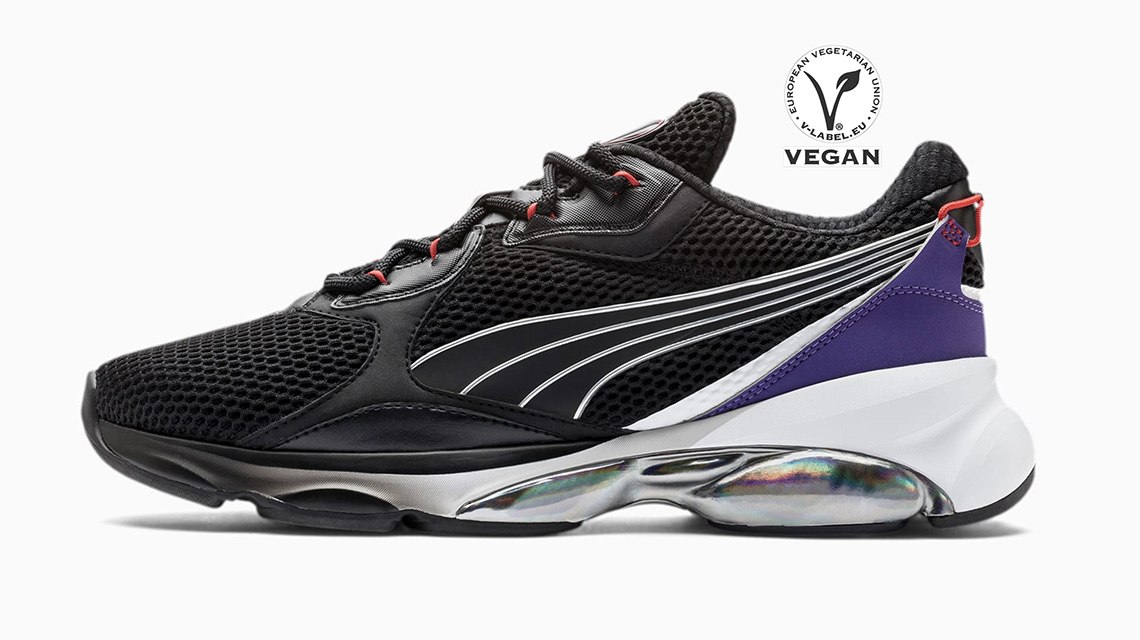
To make a vegan shoe, our manufacturers have to show that they do not use any raw materials derived from animals. We certify this process together with V-Label, an internationally recognised, registered symbol that consumers trust.
We already received two awards for our vegan products from animal rights organisation PETA. In 2018 the Shantell Martin Muse Maia received the Vegan Fashion Award and in 2020 the Nitefox Dystopia was awarded as well.
In 2020, we began to certify vegan products more actively.
To make a vegan shoe, our manufacturers have to show that they do not use any raw materials derived from animals. We certify this process together with V-Label, an internationally recognised, registered symbol that consumers trust.
We already received two awards for our vegan products from animal rights organisation PETA. In 2018 the Shantell Martin Muse Maia received the Vegan Fashion Award and in 2020 the Nitefox Dystopia was awarded as well.
In 2020, we began to certify vegan products more actively.
“We certified the first four vegan styles in SS20, in AH20 we had eleven styles and in 2021 we plan to considerably increase this number,”
Karol said.
Karol said.
Our Sportstyle business unit was the first certify vegan footwear styles. While we do not want to give away too much, we can already say that in 2021 Teamsport and Accessories will also have their own vegan styles.
If you are looking for vegan shoes, it is very easy to do so on our e-commerce store, puma.com. Just type “vegan” into the search bar and you will find the certified vegan styles that are currently on offer.
When PUMA uses animal products such as leather for items that are not certified as vegan, we have strict rules to ensure that animal welfare is respected. We do not source or process raw materials from any endangered species and we do not use leathers, hides or skins from animals that have been treated inhumanely (this includes downs and feathers that are plucked from living geese or birds or wool from mulesed sheep). We also do not and will not use any animal fur in our products.
If you are looking for vegan shoes, it is very easy to do so on our e-commerce store, puma.com. Just type “vegan” into the search bar and you will find the certified vegan styles that are currently on offer.
When PUMA uses animal products such as leather for items that are not certified as vegan, we have strict rules to ensure that animal welfare is respected. We do not source or process raw materials from any endangered species and we do not use leathers, hides or skins from animals that have been treated inhumanely (this includes downs and feathers that are plucked from living geese or birds or wool from mulesed sheep). We also do not and will not use any animal fur in our products.
What is vegan?
The term vegan was first introduced in 1944, when Donald Watson founded the vegan society in the UK. The society’s philosophy was that humans should live without exploiting animals. Veganism has become increasingly popular in the past years. In the United Kingdom, for example, the number of vegans has quadrupled between 2014 and 2019.
Catch up now speaks more languages
To enable as many users as possible to connect with us and be part of our world, we offer CATch up in English, German, French, and Spanish. Please note that these translations are automated and may contain errors.