2025 – The Year the Road Spoke Back
Marathon-tested, athlete-approved: NITRO™ technology redefining racing in 2025
December 12, 2025
PUMA did not enter elite marathon racing quietly in 2025. Across Boston, London, Salzburg, New York and Valencia, athletes wearing shoes built with the company’s state-of-the-art NITRO™ technology produced results that pushed PUMA into direct and fierce competition with brands that have dominated distance running for more than a decade.
But these performances did not emerge from irritating marketing hype, over-polished branding campaigns or aggressive athlete endorsement schemes. They emerged from timing mats, finish lists and the specific demands of four very different marathon courses.
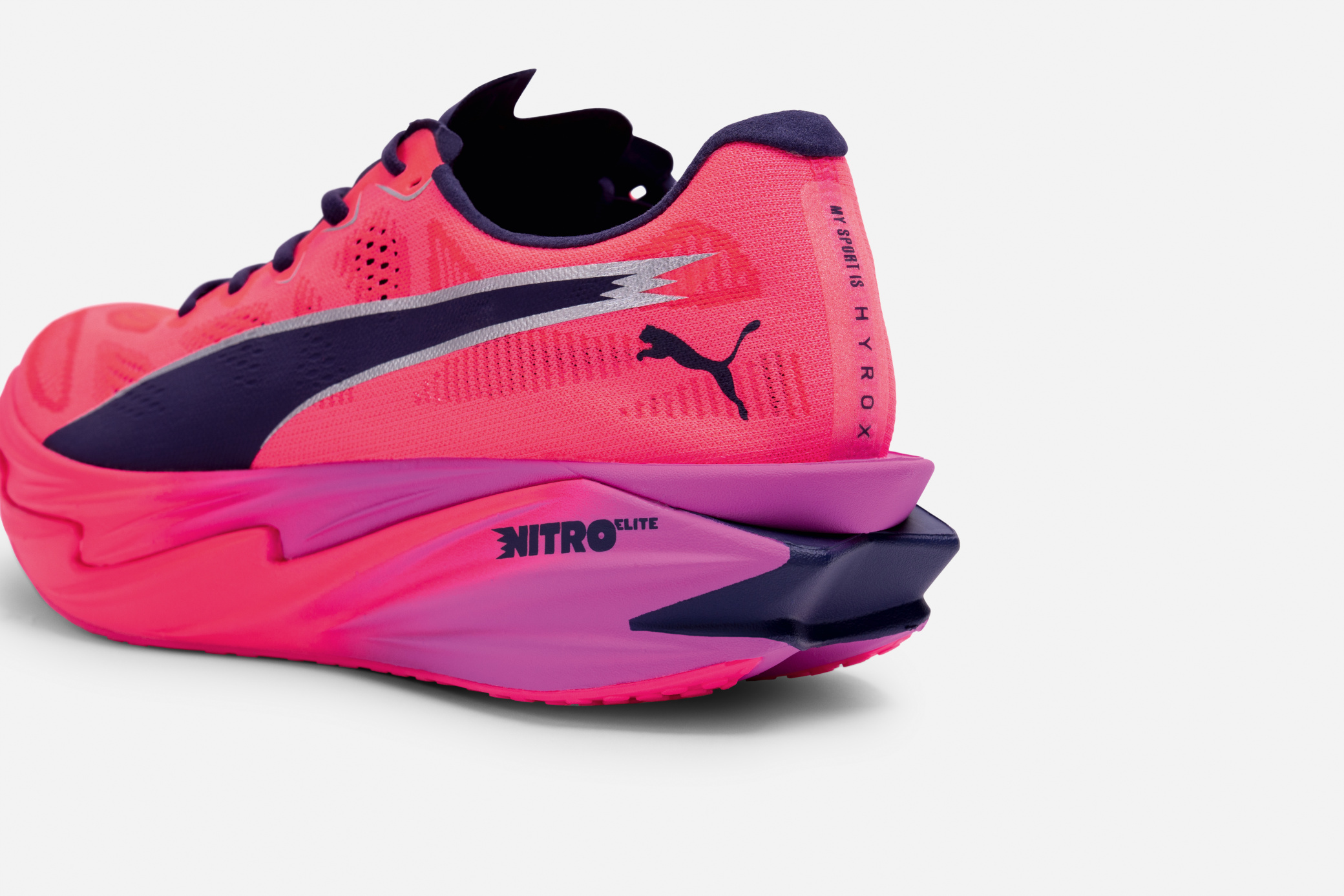
The Fast-R NITRO™ Elite 3, launched on 17 April 2025, provided the solid technological foundation for this shift. Here it leant on key findings from a University of Massachusetts Amherst study. This revealed significantly improved ‘running economy ‘- specifically how much energy (or oxygen) your body needs to run at a given steady speed, making it possible to determine how “fuel-efficient” you are when running.
Lead researcher Wouter Hoogkamer stated that “for every single participant the numbers showed that running was easiest — requiring the least amount of metabolic energy — in the Fast-R 3.” Those data points certainly set expectations, but the real test of PUMA’s seriousness was not the lab. It was what happened when the shoe confronted Boston’s hills, London’s even pacing, Salzburg’s weather, New York City’s chaos, and Valencia’s record-breaking speed.
The Fast-R NITRO™ Elite 3, launched on 17 April 2025, provided the solid technological foundation for this shift. Here it leant on key findings from a University of Massachusetts Amherst study. This revealed significantly improved ‘running economy ‘- specifically how much energy (or oxygen) your body needs to run at a given steady speed, making it possible to determine how “fuel-efficient” you are when running.
Lead researcher Wouter Hoogkamer stated that “for every single participant the numbers showed that running was easiest — requiring the least amount of metabolic energy — in the Fast-R 3.” Those data points certainly set expectations, but the real test of PUMA’s seriousness was not the lab. It was what happened when the shoe confronted Boston’s hills, London’s even pacing, Salzburg’s weather, New York City’s chaos, and Valencia’s record-breaking speed.
Boston Marathon, April 21, 2025
Boston was the turning point. Even today it remains one of the least forgiving courses in international marathon racing, with incredibly steep early descents, long, arduous climbs late in the race, unpredictable and unforgiving weather and a profile that exposes any weakness in footwear lacking propulsion, stability or cushioning under uneven force.
PUMA’s presence was immediately visible. Boston did not show isolated success. It demonstrated that PUMA’s new model could withstand a course designed to break rhythm, drain energy and punish instability. Rory Linkletter ran a personal best of 2:07:02 and Annie Frisbie ran 2:23:21, also a best.
PUMA’s presence was immediately visible. Boston did not show isolated success. It demonstrated that PUMA’s new model could withstand a course designed to break rhythm, drain energy and punish instability. Rory Linkletter ran a personal best of 2:07:02 and Annie Frisbie ran 2:23:21, also a best.
Australian Olympian Patrick Tiernan, who raced in the model, said:
“This is the first time I’ve thought that these shoes are really better than what the others are wearing.”
“This is the first time I’ve thought that these shoes are really better than what the others are wearing.”
London proves the power of pace
London, very much a different race, went on to confirm a second dimension of performance. Rather than absorbing severe terrain-based stresses, here the focus was on pace. As the London Marathon is run at a steady pace rather than with big speed changes, runners need to hold a consistent stride rate and minimise unnecessary energy use over time. Shoes should therefore make it easier to keep that rhythm and run efficiently without burning extra energy.
London marathon, April 27, 2025
PUMA footwear appeared repeatedly on athletes’ feet, and independent testers who ran the course in the Fast-R NITRO™ Elite 3 noted a clear, sustained pace deep into the race. The Run Testers wrote that the model “performed well when holding faster paces and helped runners sustain pace in late stages, even when the second half felt heavy.”
So, while the London results did not carry the same emotional punch as Boston’s cluster of personal bests, they were still critical as they showed that PUMA’s platform could support speed sustainably, not just explosively.
Then, just two weeks later, Salzburg provided the most unexpected proof point. Heavy and relentless rain, wind and brutally cold temperatures meant the race soon became far less about smooth mechanics, and more about pure survival under the sheer pressure of fatigue. High-performance racing shoes often perform very poorly in such conditions because their extreme shapes and lightweight materials tend to deteriorate very quickly when exposed to dampness, and also to uneven forces.
Yet race reports noted that athletes wearing NITRO™-equipped shoes produced some of the strongest and impressive results of the day.
So, while the London results did not carry the same emotional punch as Boston’s cluster of personal bests, they were still critical as they showed that PUMA’s platform could support speed sustainably, not just explosively.
Then, just two weeks later, Salzburg provided the most unexpected proof point. Heavy and relentless rain, wind and brutally cold temperatures meant the race soon became far less about smooth mechanics, and more about pure survival under the sheer pressure of fatigue. High-performance racing shoes often perform very poorly in such conditions because their extreme shapes and lightweight materials tend to deteriorate very quickly when exposed to dampness, and also to uneven forces.
Yet race reports noted that athletes wearing NITRO™-equipped shoes produced some of the strongest and impressive results of the day.
A review on laufen.de observed
“an exceptional level of efficiency and responsiveness, even on wet, unforgiving asphalt,” calling the shoe“ideal for marathoners pursuing a PB under tough and taxing conditions.”
“an exceptional level of efficiency and responsiveness, even on wet, unforgiving asphalt,” calling the shoe“ideal for marathoners pursuing a PB under tough and taxing conditions.”
Though the Salzburg Marathon had nothing of the global reach of either Boston or London, the severity of the environment made it a form of natural experiment, allowing runners and the public alike to discover just what can happen when a racing shoe designed for efficiency is confronted head on with adversity.
MaStering the Chaos on New yorks roads
Patrick Dever finishes 4th at the New York Marathon
annie frisbie finishes 5th at the New York Marathon
Another major test of 2025, the New York City Marathon, is known as one of the most technically demanding of its kind in the whole world. Here bridges, sustained elevation changes, a series of sharp and sudden turns, exposure to merciless winds and late-race climbs make it extremely difficult to both build and maintain rhythm. For many shoes, New York ends up exposing hidden problems that tend to remain completely invisible in flatter marathons, be this anything from instability to slippage to midsole fatigue. And it also reveals the dreaded curse of poor energy transfer when ‘fresh form’ – the good running technique people have at the start of the race, can break down through to fatigue, resulting in everything from sloppy posture to shorter strides.
Reports from 2025 noted a strong PUMA presence in top-ten results. PUMA’s own communications described the season as “one of the most extensive on-road performance trials we have undertaken,” acknowledging that results had been achieved not through controlled laboratory environments but through open competition in four very different settings. New York did not simply confirm the shoe’s potential — it totally validated its performance in a race that punishes inefficiency more ruthlessly than almost any other major marathon.
Reports from 2025 noted a strong PUMA presence in top-ten results. PUMA’s own communications described the season as “one of the most extensive on-road performance trials we have undertaken,” acknowledging that results had been achieved not through controlled laboratory environments but through open competition in four very different settings. New York did not simply confirm the shoe’s potential — it totally validated its performance in a race that punishes inefficiency more ruthlessly than almost any other major marathon.
records in valencia
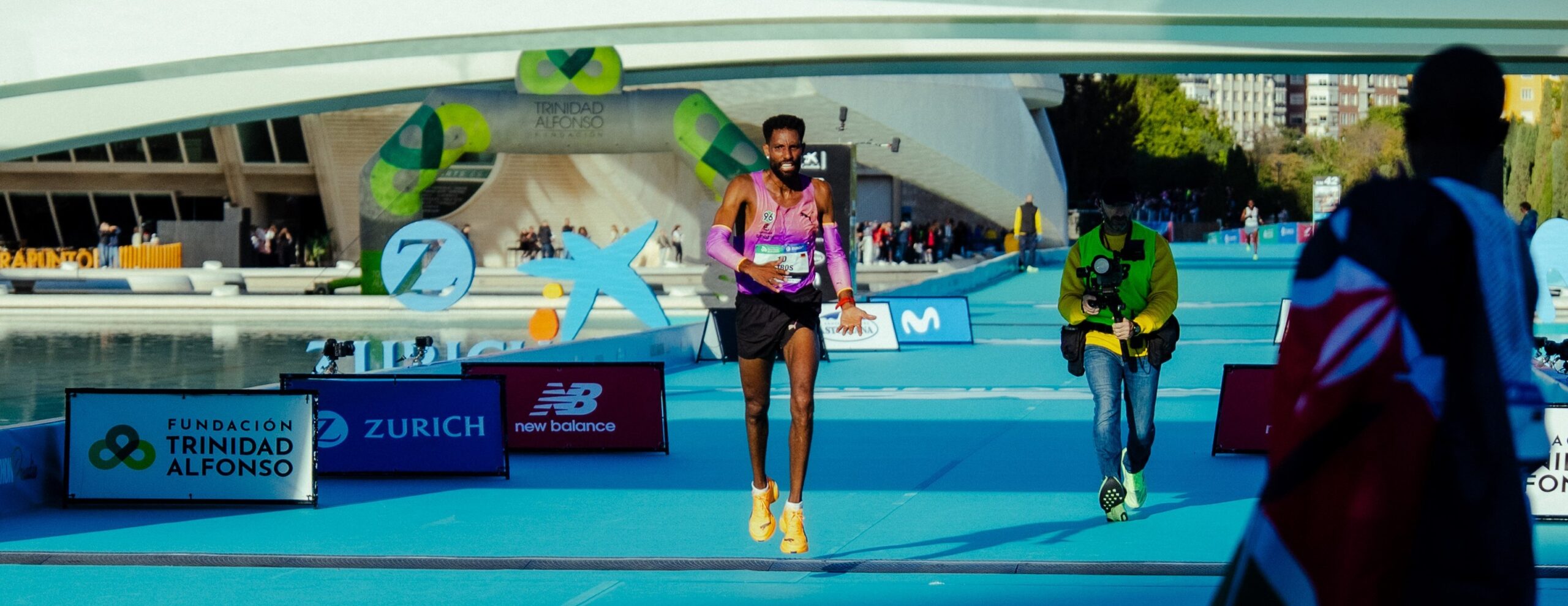
Valencia delivered a spectacular finale to PUMA’s 2025 marathon season. Known as one of the fastest marathons in the world, Valencia combines a flat, lightning-quick course with near-perfect racing conditions, making it a magnet for record-breaking performances. On this stage, Amanal Petros stormed to second place in 2:04:04 — a new German national record, the fastest marathon ever run by a PUMA athlete, and the third fastest in European history. Chloe Herbiet added to the triumph with a third-place finish in 2:20:38, smashing her previous best and becoming the sixth fastest European woman of all time. Both athletes raced in the FAST-R NITRO™ Elite 3, reinforcing its reputation as the ultimate race-day shoe.Amanal Petros (l) with his PUMA Manager Dario (m) and running coach Ben (r)
Across these events, the contribution of NITRO™ technology was visible not in slogans but in outcomes. The running shoes demonstrated stability through Boston’s downhill pounding, durability through Salzburg’s conditions, efficiency across London’s flat, sustained pacing and responsiveness under New York City’s constant interruptions, and pure speed in Valencia. The cumulative pattern — personal bests in Boston, sustained pace in London, resilience in Salzburg, top-tier placements in New York and historic records in Valencia — provided PUMA with a spectrum of competitive evidence that even the slickest of marketing campaigns could ever hope to simulate.
Fast-R3 elite Built to go further
Independent reviewers provided context for what made these outcomes possible, but they were equally clear about the limitations. RunRepeat described the Elite 3 as “one of the most aggressive supershoes ever made” and noted that testers found it “explosively fast, delivering a thrilling experience that few competitors can match“. RunningShoesGuru concluded that while the shoe was “a good racer with a fast ride” it “requires you to have very good running form due to its instability,” and suggested that “for most runners, it’s only suitable for half marathons or shorter races.”These industry assessments explain why the 2025 outcomes were so striking. The Elite 3 is not a general-purpose solution for all marathon runners, rather a specialist tool that rewards efficient biomechanics – and punishes anything less! And though this feature makes the shoe less useful for many – even most runners, it also helps explain why elite runners could still secure a significant advantage. After all, they keep their technique consistent even when runners and hit by fatigue, allowing them to use the shoe’s benefits despite gruelling conditions. And the shoe’s exceptionally low weight, measured at around 170 grams, served to powerfully reinforce that edge.
T
he significance of the 2025 season lies not simply in performance but in method. PUMA returned to elite marathoning not through a single, loud, headline-grabbing result. It was achieved through a sequence of outstanding events in which NITRO™-equipped athletes posted competitive outcomes across race architectures and incredibly strenuous environmental conditions that have historically defeated new products. The company did not rely on controlled rollouts or closed-door performance claims. It put its product in open competition and allowed the sport to deliver an extraordinary verdict.
The broader implication is that PUMA introduced a credible alternative design philosophy within the super-shoe market. Whereas the early era of carbon-plate racing shoes was driven by maximal stack heights and foam volume, PUMA’s NITRO™ line prioritised themes of weight, energy efficiency and controlled propulsion. Crucially, NITRO™ — and specifically NITRO™ ELITE — delivered the highest energy return of any foam available in 2025. This meant more of the force from each step was recycled into forward motion, helping athletes maintain speed later in races. The foam bounced back more energy than anything else on the market, and, as a result, runners could go fast with less effort, especially when the dreaded curse of fatigue started to set in.
2025 – Dominance through Innovation
What 2025 demonstrated is not that PUMA reinvented marathon running, but that it re-entered it with evidence rather than mere ambition. The Fast-R NITRO™ Elite 3 across four major races proved capable of supporting elite-level results under conditions that traditionally destroy unproven footwear. And in a sport where performance margins are measured in seconds, PUMA spent 2025 establishing that its technology could matter again — not in theory but on the road!
PUMA’s development approach in this cycle was built not around isolated laboratory targets but around athletes themselves. The company spent years in direct conversation with elite runners, collecting feedback and capturing performance data, while iterating hundreds of digital prototypes. This prototyping process was a game changer: hundreds of configurations were tested and simulated digitally, enabling rapid learning so that the first physical prototype was almost perfect. Ultimately, testing the first real sample was amazing because it responded to real-world needs rather than abstract design goals.
Though the Fast-R NITRO™ Elite 3 began with the athlete at the centre, it ultimately returned to them with measurable gains in performance.
And now, having successfully closed that loop, PUMA loop — and is already working on the exciting next step on the journey!
he significance of the 2025 season lies not simply in performance but in method. PUMA returned to elite marathoning not through a single, loud, headline-grabbing result. It was achieved through a sequence of outstanding events in which NITRO™-equipped athletes posted competitive outcomes across race architectures and incredibly strenuous environmental conditions that have historically defeated new products. The company did not rely on controlled rollouts or closed-door performance claims. It put its product in open competition and allowed the sport to deliver an extraordinary verdict.
The broader implication is that PUMA introduced a credible alternative design philosophy within the super-shoe market. Whereas the early era of carbon-plate racing shoes was driven by maximal stack heights and foam volume, PUMA’s NITRO™ line prioritised themes of weight, energy efficiency and controlled propulsion. Crucially, NITRO™ — and specifically NITRO™ ELITE — delivered the highest energy return of any foam available in 2025. This meant more of the force from each step was recycled into forward motion, helping athletes maintain speed later in races. The foam bounced back more energy than anything else on the market, and, as a result, runners could go fast with less effort, especially when the dreaded curse of fatigue started to set in.
2025 – Dominance through Innovation
What 2025 demonstrated is not that PUMA reinvented marathon running, but that it re-entered it with evidence rather than mere ambition. The Fast-R NITRO™ Elite 3 across four major races proved capable of supporting elite-level results under conditions that traditionally destroy unproven footwear. And in a sport where performance margins are measured in seconds, PUMA spent 2025 establishing that its technology could matter again — not in theory but on the road!PUMA’s development approach in this cycle was built not around isolated laboratory targets but around athletes themselves. The company spent years in direct conversation with elite runners, collecting feedback and capturing performance data, while iterating hundreds of digital prototypes. This prototyping process was a game changer: hundreds of configurations were tested and simulated digitally, enabling rapid learning so that the first physical prototype was almost perfect. Ultimately, testing the first real sample was amazing because it responded to real-world needs rather than abstract design goals.
Though the Fast-R NITRO™ Elite 3 began with the athlete at the centre, it ultimately returned to them with measurable gains in performance.
And now, having successfully closed that loop, PUMA loop — and is already working on the exciting next step on the journey!
Catch up now speaks more languages
To enable as many users as possible to connect with us and be part of our world, we offer CATch up in English, German, French, and Spanish. Please note that these translations are automated and may contain errors.