Spikes, stories and the smell of success
Two legends revisit the PUMA Archive
September 9, 2025
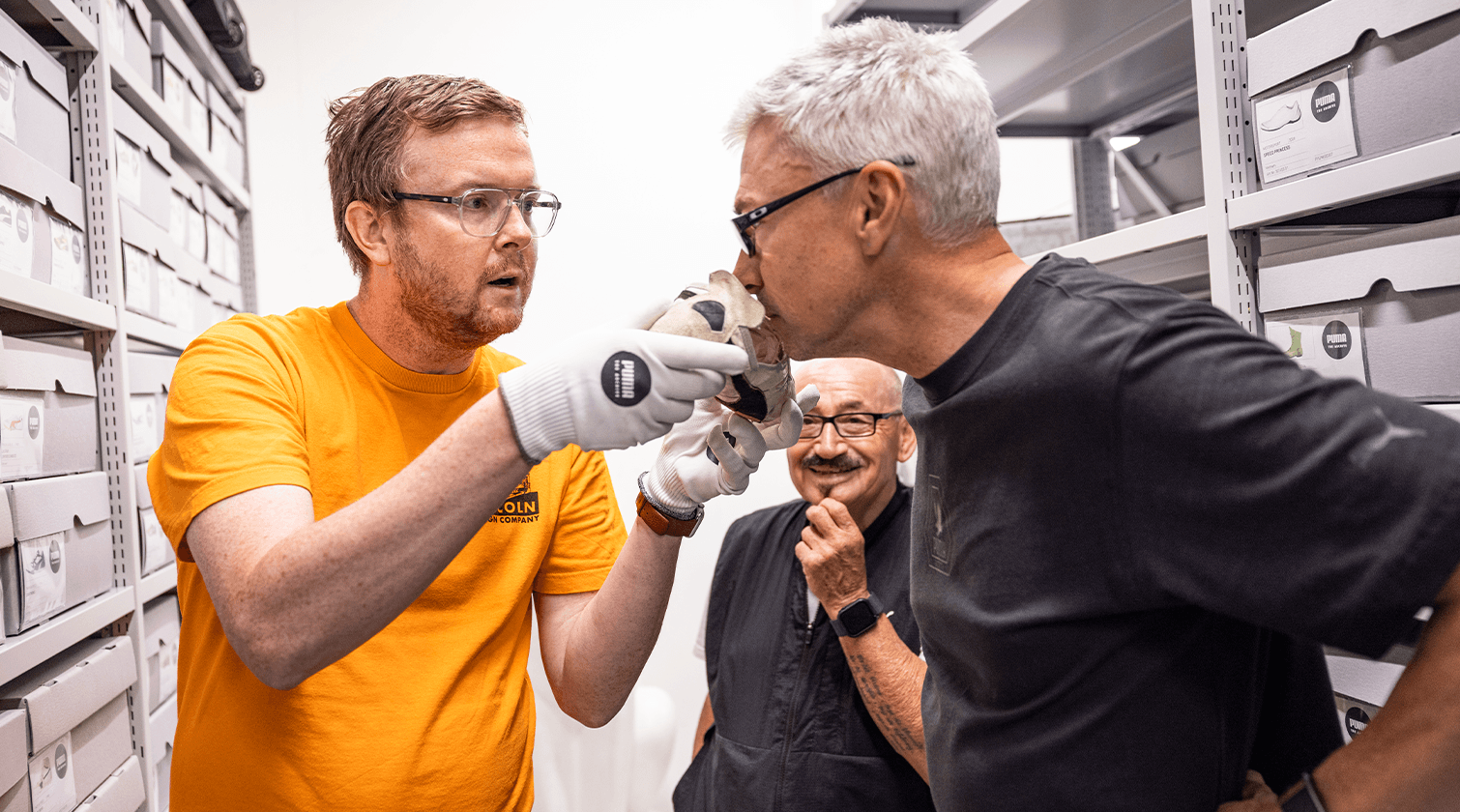
“Is that a Munich?” asks Colin Jackson as he lifts a red spike from the shelves of the PUMA archive. For the hurdling legend, it’s a piece of his youth – his very first shoe, worn at the age of 15. Next to him, Jonathan Edwards, triple jump world record holder, smiles, turning another spike in his hand before bringing it to his face: “Smells like a winner.”
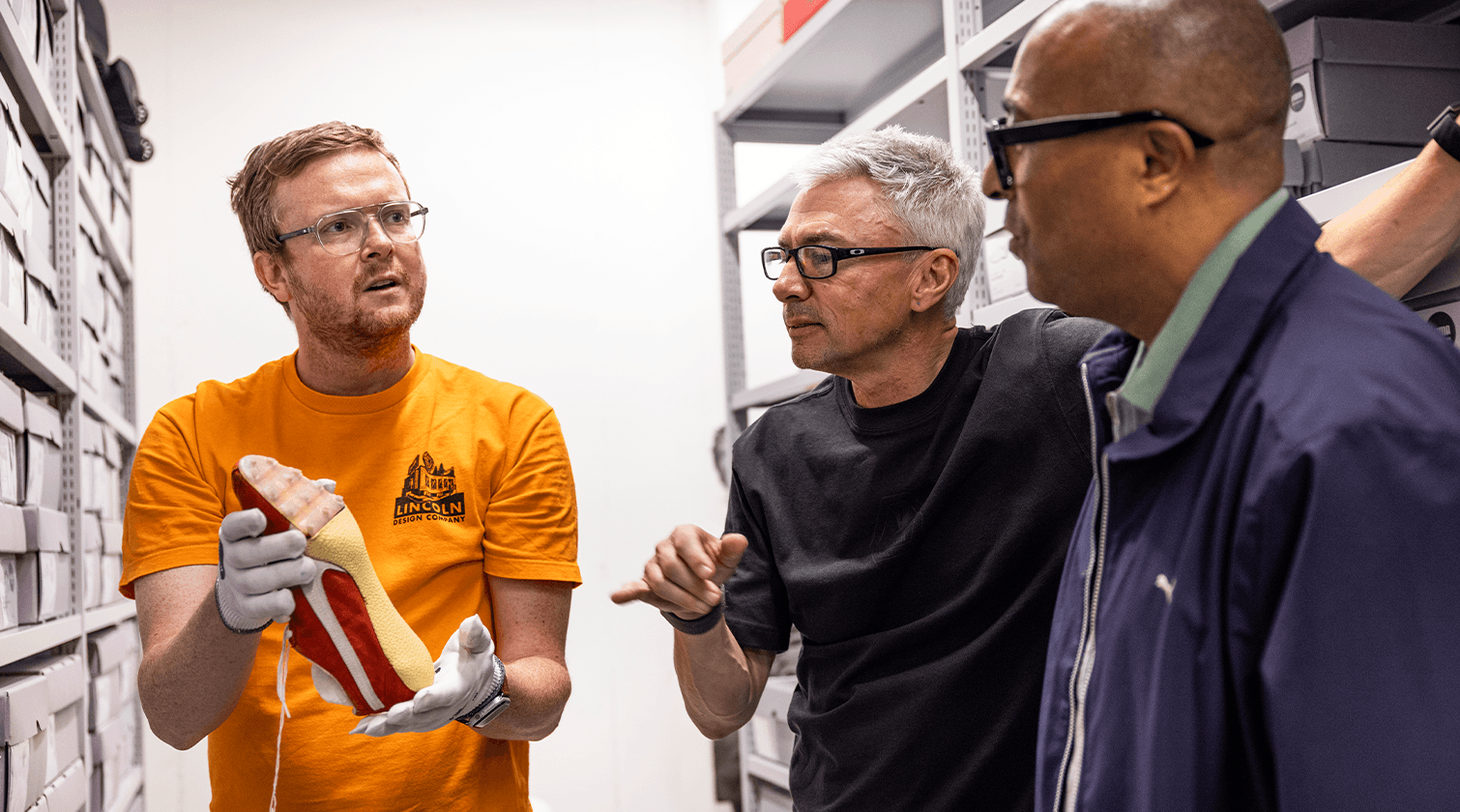
The two legends, who wrote history with world records in hurdles and the triple jump, let themselves be carried back by the old models to a time when spikes represented the cutting edge of innovation – lightweight, precisely crafted, ahead of their time. Today they may look almost simple, but the contrast makes clear how fast technology has evolved.
Colin Jackson and Jonathan Edwards explain why the right equipment made all the difference, how shoes and materials have changed since then – and why technology will once again play a crucial role at the World Athletics Championships in Tokyo this month.
Colin Jackson and Jonathan Edwards explain why the right equipment made all the difference, how shoes and materials have changed since then – and why technology will once again play a crucial role at the World Athletics Championships in Tokyo this month.
Jonathan Edwards
triple jump legend, Olympic champion, and world record holder.
Colin Jackson
hurdles legend, World and European champion, and former WR holder.
Sitting here in the PUMA Archive, surrounded by spikes, jerseys, and memories from the past, what went through your mind?Colin Jackson: Walking through the Archive is like stepping back in time. You see the shoes, the different colorways, the kits, and it takes you right back to moments on the track. Then you spot your own name on a pair of spikes you competed in – that’s really special. It feels like opening a time capsule and puts a huge smile on my face.
Jonathan Edwards: For me, it’s about seeing the essence of PUMA. The Archive shows the innovation, the passion, and the love of sport that have always been at the heart of the company. When you walk in here, you’re not just looking at products – you’re stepping into PUMA’s DNA. It’s really special, I love it down here!
Jonathan Edwards: For me, it’s about seeing the essence of PUMA. The Archive shows the innovation, the passion, and the love of sport that have always been at the heart of the company. When you walk in here, you’re not just looking at products – you’re stepping into PUMA’s DNA. It’s really special, I love it down here!

Looking back at your gear: Was there anything you wish you had? Or did you feel equipped for your time?Jonathan: I felt completely equipped – what we had was the best of its era. But if I could have combined my prime form with today’s technology, that would be fascinating. The new spikes really do give athletes a measurable advantage. You can see it in the performances today.
Colin: I was the same – my spikes were ready to race in straight away, no breaking in. I never felt disadvantaged. But if we’d had today’s innovations, it could have made a huge difference, for sure.
Colin: I was the same – my spikes were ready to race in straight away, no breaking in. I never felt disadvantaged. But if we’d had today’s innovations, it could have made a huge difference, for sure.
Was there one breakthrough product that made you think: “This changes everything”?Colin: For me, it was the PUMA Disc. The fit was perfect – the balance and weight were exactly where I needed them. It gave me confidence straight away, and as an athlete, that belief in your product is priceless. And yes, even color mattered! I loved my black signature spikes because they made me feel great. And if you looked good, you felt good, and that helped you perform.
Jonathan: I never wore the Disc; I stuck with laces, but for me, it was more about gradual evolution. Innovations were launched, like sharkskin, plastic plates, and so many different colorways. The sharkskin sole worked brilliantly in all conditions. Later, we switched to plastic plates – they looked fantastic, until it rained. Plastic on a wet starting block is no fun; your foot can slip much more easily. Every year we had something new to test and would keep what we liked. Each step brought improvements, even if some came with lessons.
Jonathan: I never wore the Disc; I stuck with laces, but for me, it was more about gradual evolution. Innovations were launched, like sharkskin, plastic plates, and so many different colorways. The sharkskin sole worked brilliantly in all conditions. Later, we switched to plastic plates – they looked fantastic, until it rained. Plastic on a wet starting block is no fun; your foot can slip much more easily. Every year we had something new to test and would keep what we liked. Each step brought improvements, even if some came with lessons.

When you think of the future of athletics – new talents, new technologies – what do you hope for?Colin: I think the sport is in a strong place. Fans love it, athletes are pushing harder than ever, and major championships still create unforgettable moments. I saw it in Paris last year, the crowd celebrated every winner, not just the French. That passion shows athletics has a great future.
Jonathan: I don’t think athletics is as dominant as it once was among other sports. But I believe showcasing the technological side, the innovation behind the sport, as well as the physical effort, can help spark new interest and reinvigorate it. The core of athletics is outstanding – it’s tough, hard to succeed in, and hard to sustain, and still appreciated. You can see that at major championships, where fans love it. But the Diamond League – the circuit, as we would say – needs transformation. And technology could play a big role in making people fall in love with the sport again.
Jonathan: I don’t think athletics is as dominant as it once was among other sports. But I believe showcasing the technological side, the innovation behind the sport, as well as the physical effort, can help spark new interest and reinvigorate it. The core of athletics is outstanding – it’s tough, hard to succeed in, and hard to sustain, and still appreciated. You can see that at major championships, where fans love it. But the Diamond League – the circuit, as we would say – needs transformation. And technology could play a big role in making people fall in love with the sport again.
Thank you so much, Jonathan and Colin, for going down memory lane with us in the PUMA Archive!
Colin Jackson reminisces:
“This was in Miami, for a PUMA Cell shoot if I remember correctly. And the puma was named Kitty. She was incredible – we even took her to the beach in one scene. For this particular shoot, they warned me never to drop my head below hers, or I’d be challenging her dominance. I stayed upright the whole time but you know, you get tired, so I relaxed for a moment… and Kitty smacked me straight in the face. That’s when I thought, okay, enough — and walked out. Nobody argued.”
A special Archive treasure
More stories
Catch up now speaks more languages
To enable as many users as possible to connect with us and be part of our world, we offer CATch up in English, German, French, and Spanish. Please note that these translations are automated and may contain errors.