„YOU JUST FEEL IT“
How PUMA combines its NITRO™ technology with carbon to create a new running experience
January 7, 2026
In motorsport, high-performance sailing, racing bikes or aviation – almost nothing that aims to go fast does so without carbon anymore. It can be shaped precisely, loaded aggressively and still return to its original form. Carbon does not buckle, it yields. We caught up with PUMA’s carbon expert Matthias Hartmann, explaining how PUMA leverages carbon and why its combination with NITRO™ technology sets a new benchmark for performance.
Translating energy into motion rather than merely storing it. That is the point at which carbon becomes relevant in a running shoe. Carbon is a material that changes how force is generated and released. That is where the story starts for PUMA: not with the shoe, but with the movement itself. Or, as Matthias Hartmann, Head of Material Engineering Innovation Footwear, puts it: “You can tell the material what it’s supposed to do.”
PUMA was among the first sports brands to recognize this potential. As early as 2006, the company integrated a carbon plate into the v1.06 football boot – long before carbon was discussed as a performance engine in running. Back then it wasn’t about records. It was about weight, stability and pressure distribution. Carbon was the first material stiff enough to add support without adding mass. “Carbon offers the best ratio of weight to stiffness. You can make something extremely rigid without making it heavy,” says Hartmann. For footballers, that meant more stability without extra bulk and, crucially, a more even pressure pattern under the studs. As Hartmann sums it up: “It doesn’t feel like you’re standing on single points anymore.”
Matthias Hartmann, Head of Material Engineering Innovation Footwear, says: “You land differently. You roll differently. You set your toe-off more efficiently. That changes everything.”
Once running began to move beyond cushioning and into the realm of manipulating running mechanics, carbon returned to center stage. The move from the pitch to the marathon course was no coincidence; it was the logical consequence of material meeting biomechanics. Carbon does not alter the foot. It alters the way the foot behaves. Every person has a natural running pattern. Carbon nudges that pattern without breaking it. “You land slightly differently, you roll differently, you push off more efficiently. That changes everything,” says Matthias Hartmann.
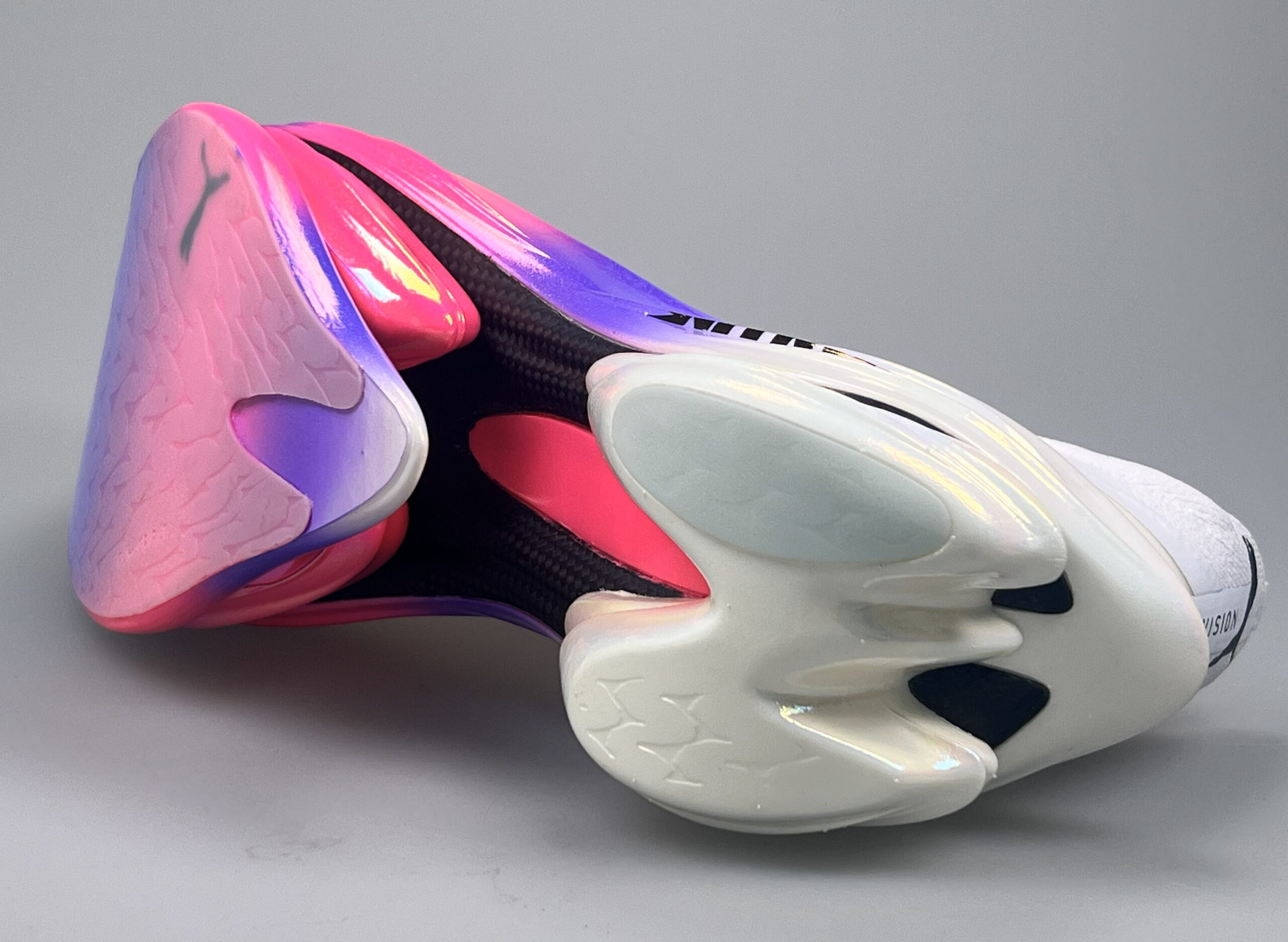
Carbon consists of thousands of carbon filaments, thinner than a human hair, layered into textiles and embedded into a polymer matrix before being cured. The orientation of these fibers determines how forces are absorbed and returned. “Traditional plastics become sluggish over time. They creep, they lose tension, and they don’t fully return to their original position,” he explains. Carbon does the opposite. “It stores energy and releases it again without changing.”
Carbon consists of thousands of carbon filaments, thinner than a human hair, layered into textiles and embedded into a polymer matrix before being cured. The orientation of these fibers determines how forces are absorbed and returned. “Traditional plastics become sluggish over time. They creep, they lose tension, and they don’t fully return to their original position,” he explains. Carbon does the opposite. “It stores energy and releases it again without changing.”
A material with snappiness
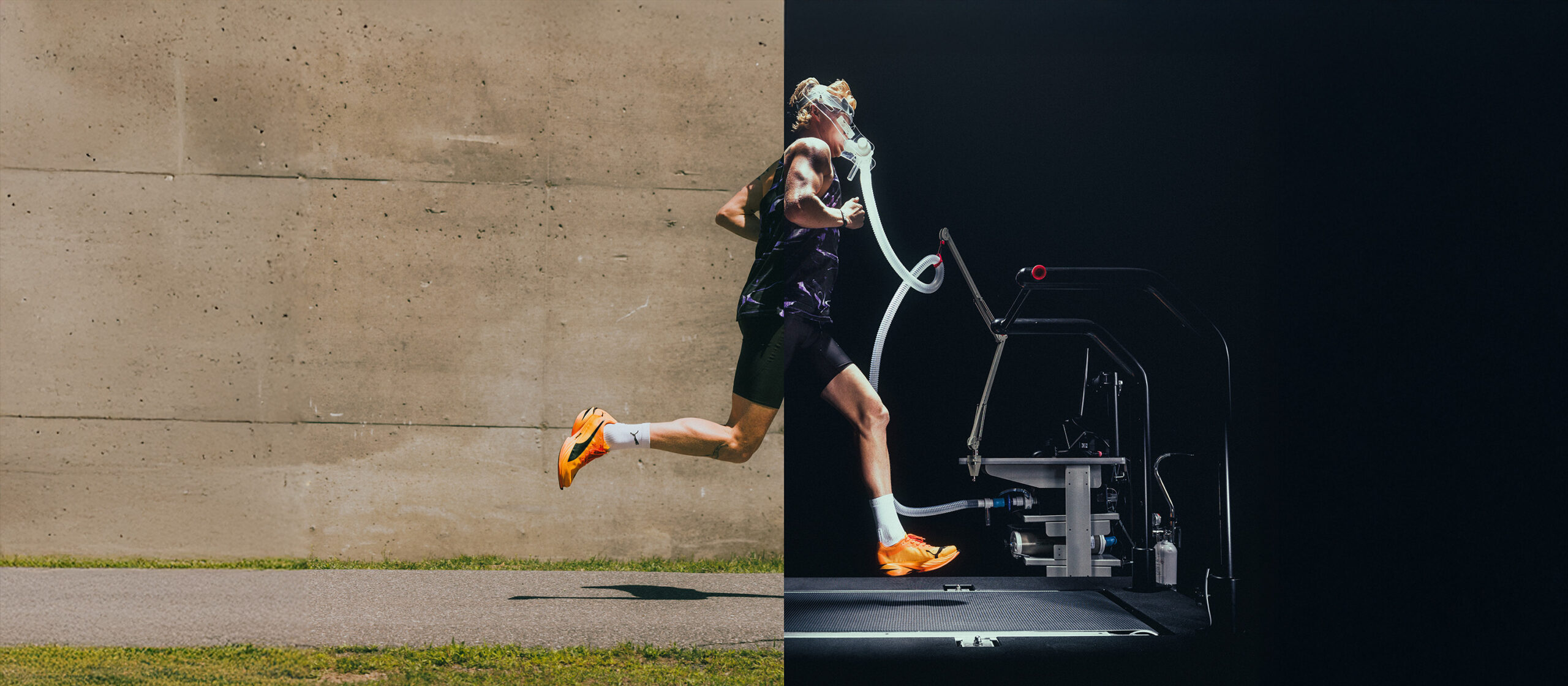
At PUMA, there is a word for that behavior: snappiness. “If you bend the plate and let go, it snaps right back. It feels like the shoe pushes you forward.” This instant feedback becomes a physical impulse that redirects energy. NITRO™ foams amplify that effect.“Carbon in combination with NITRO™ creates a new running experience.”
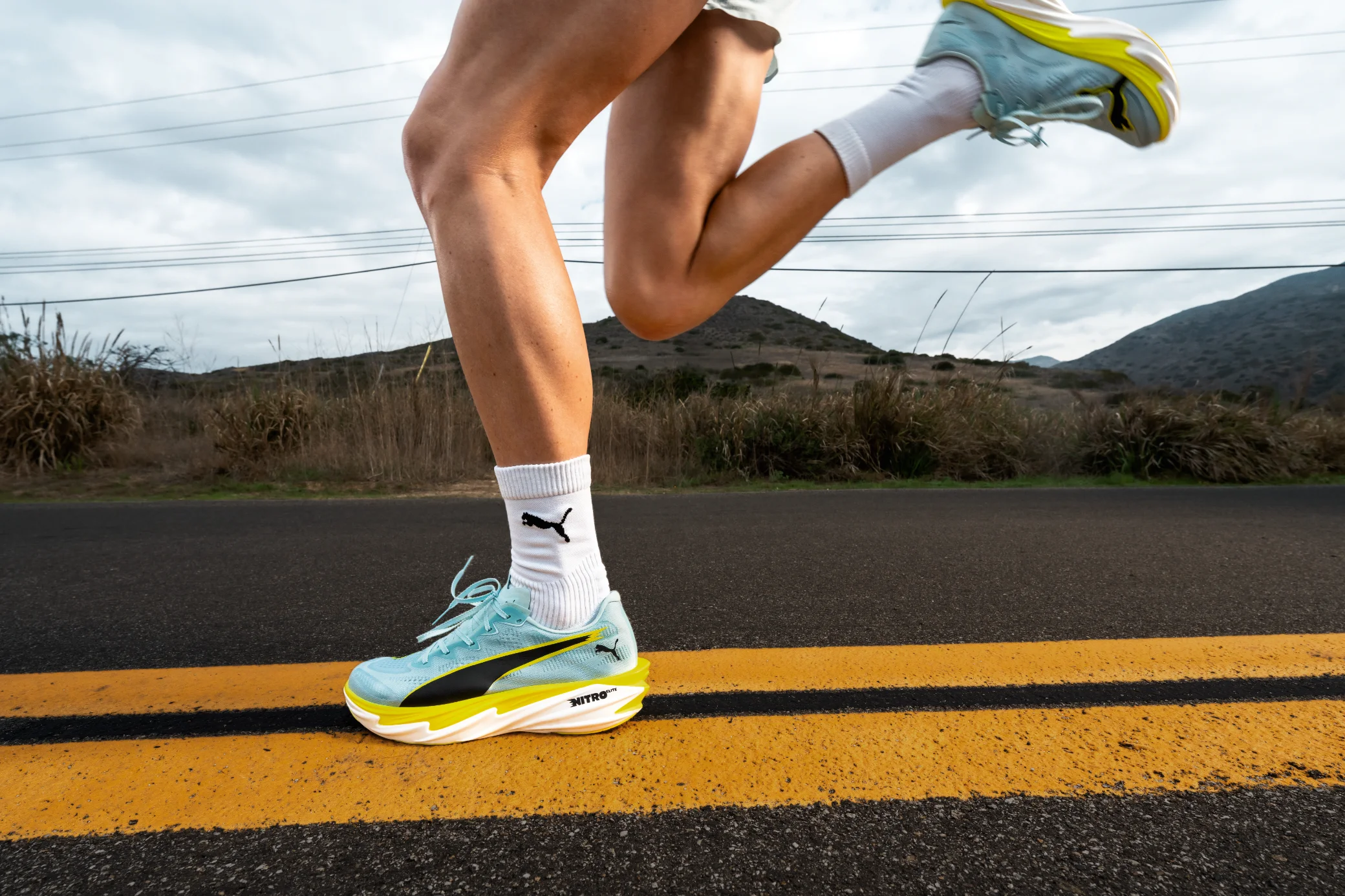
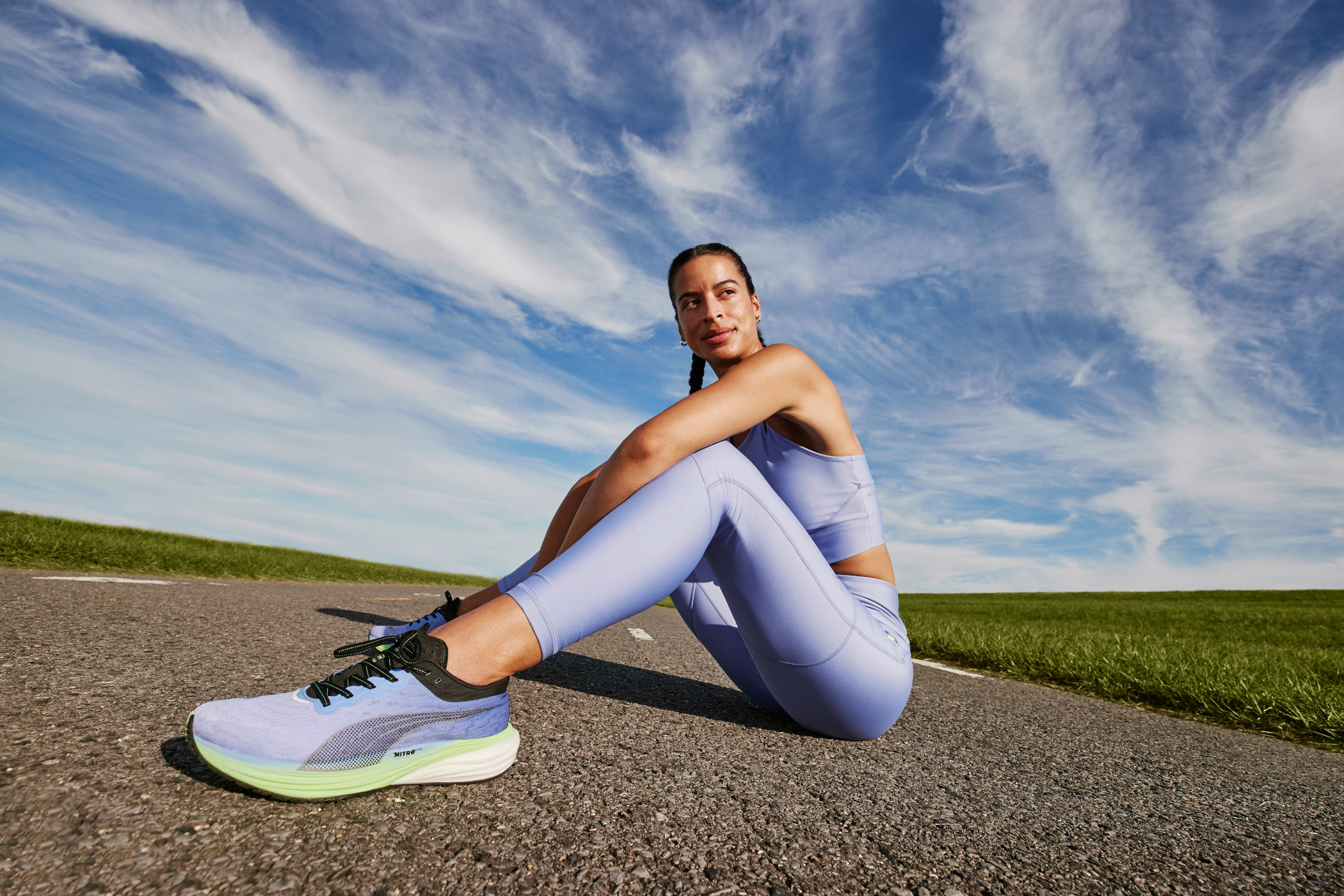
“Carbon on its own does not make a fast running shoe. But Carbon in combination with NITRO™ creates a new running experience.” Today, this development is embodied in PUMA’s current performance running shoes such as the Deviate NITRO™ Elite 3 and the Fast-R NITRO™ Elite 3.
The sensation is so distinct that language struggles to keep up. Runners describe it intuitively. Stride length changes, ground contact time drops, acceleration happens before the mind registers it. Hartmann reduces it to a single sentence: “You just feel it.”
The sensation is so distinct that language struggles to keep up. Runners describe it intuitively. Stride length changes, ground contact time drops, acceleration happens before the mind registers it. Hartmann reduces it to a single sentence: “You just feel it.”
And yet he warns against treating carbon as a universal solution. “The plate doesn’t belong in every shoe. The human foot has optimized itself over millions of years. It’s perfect if you let it do its job.” Carbon doesn’t perfect the person, it perfects a moment. “A shoe with a carbon plate is a tool for competition. If you run with it all the time, you take work away from the foot that it actually needs to do.” Training shoes build muscle. Carbon shoes release it. Confuse the two, and you’re not training the body anymore – you’re training the material.
Expanding movement itself
Parasport adds another layer to the story. Here, carbon does not only assist the body; it extends it. Carbon blades and plates store and return energy in ways biological structures cannot. For athletes like Felix Streng, carbon has changed the sensation of sprinting as much as the mechanics. The motion doesn’t end at the foot – it starts there.For the Head of Material Engineering Innovation Footwear, the future isn’t replacement, but refinement. Carbon will not disappear; it will become more precise. Fiber layups, resins, geometries and foams will evolve. “We’re only at the beginning.” Perhaps, one day, a shoe won’t just make someone faster – it will match how they run. Perhaps carbon won’t only accelerate movement, but correct it. Who can say what will be possible tomorrow?
Catch up now speaks more languages
To enable as many users as possible to connect with us and be part of our world, we offer CATch up in English, German, French, and Spanish. Please note that these translations are automated and may contain errors.